
Ask any defence aspirant what scares them most, and nine out of ten will say the same thing — “Sir, SSB interview ke andar hota kya hai, kisi ne clearly nahi bataya.” And honestly, that’s the biggest problem. Most candidates walk in blind, running purely on WhatsApp forwards and YouTube rumours, and that’s exactly why they carry unnecessary tension for five whole days.
Let me clear the fog for you, because I’ve watched this process from the inside for over three decades.
Here’s the first thing you need to accept — SSB is not testing what you know. It’s testing who you are. There’s no textbook for that. You can’t mug up “how to be a good leader” the night before, the same way you crammed history dates for your board exams. This is a five-day mirror, and whatever shows up in that mirror is what gets evaluated.
The entire system runs on a simple but powerful idea — Mansa, Vacha, Karmana — your thoughts, your words, and your actions should all match. If you think one way, say another, and behave completely differently under pressure, the assessors will catch it. Not because they’re trying to trap you, but because three independent specialists — a Psychologist, a GTO, and an Interviewing Officer — are quietly studying different parts of your personality, without even talking to each other until Day 5.
So let’s walk through this journey exactly as it unfolds, day by day.
Before Day 1: The Arrival
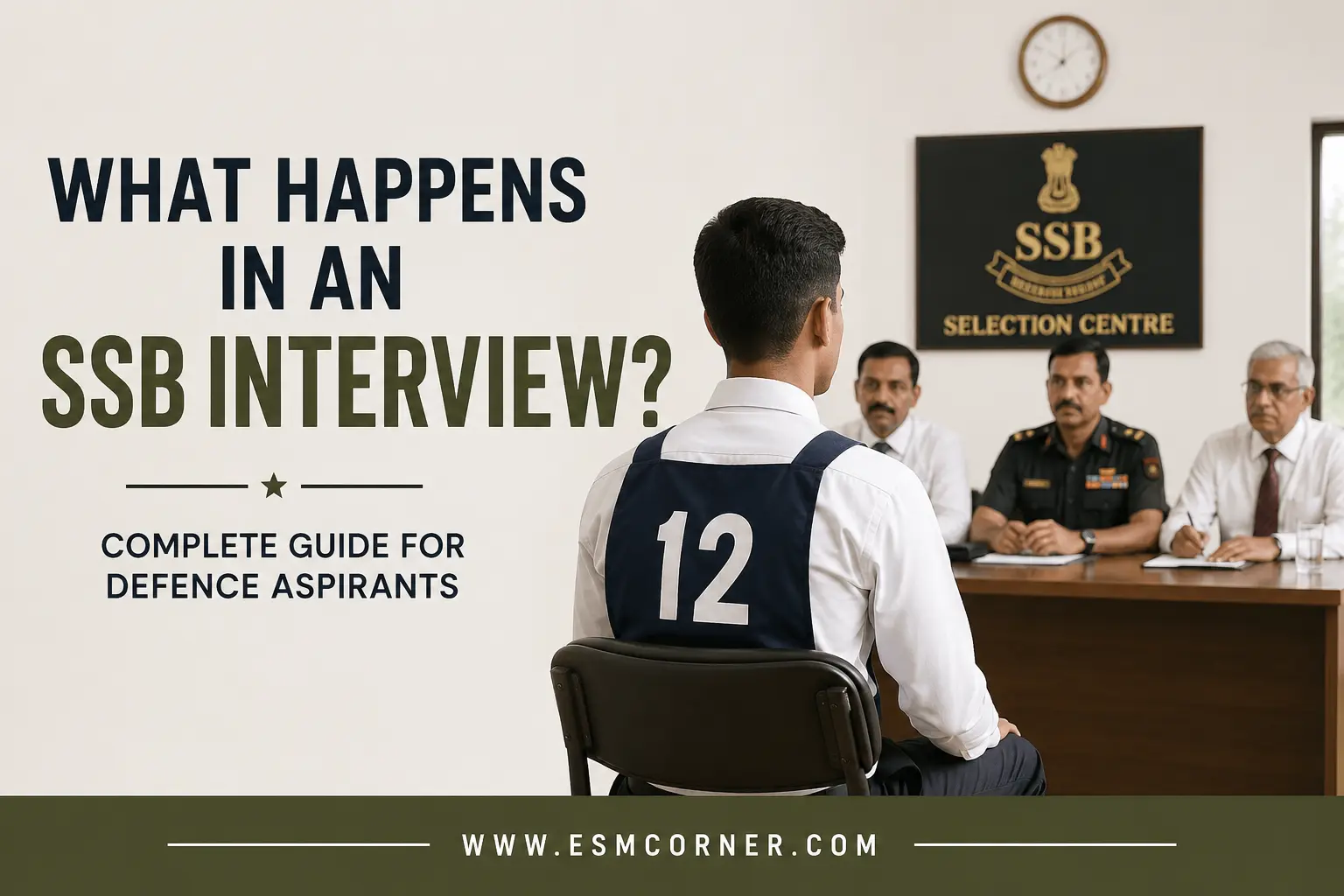
You reach the railway station or the Selection Centre as mentioned on your call letter. Documents get checked thoroughly — original certificates, ID proof, photographs, everything. Once you clear this formality, you’re handed something that becomes your identity for the next five days — your chest number. From this point on, nobody really cares what your name is. You’re “Chest Number 14” or “Chest Number 32” to the entire board.
You get your barrack, a briefing about rules and discipline, and just like that, your SSB journey officially begins.
Day 1: Screening — The Day That Filters Out the Crowd
This is the day where the maximum number of candidates go home. Brutal, but true. Day 1 has two parts:
- OIR Test (Officer Intelligence Rating) — verbal and non-verbal reasoning questions, solved in two timed booklets. This checks your mental speed and accuracy, nothing fancy, just how sharp your brain is under a ticking clock.
- PPDT (Picture Perception and Description Test) — you’re shown a blurry, hazy picture for just 30 seconds. In that short glimpse, you note down the characters, mood, and action you perceived, then write a short story in four minutes. After that, you narrate it and discuss it with your group to reach one common story.
Here’s what most candidates get wrong — they either write an overly dramatic, filmy story, or they panic and write something too plain and lifeless. Neither works. The board wants realistic, practical thinking — a normal situation, a normal problem, and a sensible solution. That’s it.
Quick Tips for Day 1:
- Practice OIR questions to build speed, not just accuracy
- In PPDT, don’t force unnecessary drama into your story — keep it believable
- During group discussion, don’t shout to be heard — contribute meaningfully and let others speak too
Day 2: The Psychology Day — Your Subconscious on Paper
If Day 1 filters people out, Day 2 quietly digs into your mind. This is where the Psychologist takes over, using four tests to understand what you genuinely think, not what you want them to think.
Here’s a simple breakdown of what each test actually studies:
| Psychological Test | What You Do | What It Actually Reveals |
|---|---|---|
| TAT (Thematic Apperception Test) | Write short stories based on pictures shown briefly | Your imagination, problem-solving style, and attitude toward challenges |
| WAT (Word Association Test) | Write the first thought that comes to mind for a series of words | Your natural mindset and instinctive personality traits |
| SRT (Situation Reaction Test) | Give quick, practical responses to real-life situations | Your decision-making, sense of responsibility, and ability to handle pressure |
| SDT (Self-Description Test) | Describe yourself through your own eyes and through family, friends, teachers’ views | Your self-awareness, honesty, and maturity |
The one mistake candidates repeatedly make here — they try to build a “hero version” of themselves on paper. Don’t. The Psychologist has read thousands of these tests; a fake, overly perfect personality is easier to spot than you’d think. Write what’s natural and honest, not what sounds impressive.
Days 3 & 4: GTO Tasks — Personality in Action
Till now, everything was written or spoken in a controlled setting. GTO days change the game completely — now your personality is tested live, out in the open field, with your group watching and reacting in real time.
The GTO series typically includes:
- Group Discussion
- Group Planning Exercise
- Progressive Group Task
- Half Group Task
- Group Obstacle Race
- Lecturette (a short solo speech)
- Individual Obstacles
- Command Task
- Final Group Task
Each of these tests a different flavour of your personality — the Group Discussion checks awareness and communication, the Command Task checks how you handle responsibility when you’re suddenly put in charge, and Individual Obstacles simply check your raw courage and physical stamina.
Here’s the honest truth from someone who has watched hundreds of these tasks — the candidates who impress the board most are rarely the loudest ones trying to dominate every task. It’s usually the quieter, consistent performer who genuinely helps the team move forward, listens to others’ ideas, and stays positive even when a task goes wrong.
Common mistakes to avoid during GTO:
- Trying to “prove leadership” by talking over everyone
- Ignoring teammates’ ideas just to push your own
- Focusing only on your personal performance instead of the group’s success
Days 4 & 5: Personal Interview and The Final Conference
Somewhere between your GTO days, you’ll also have your Personal Interview — a detailed one-on-one conversation with the Interviewing Officer, based entirely on the form you filled earlier (called the PIQ). Expect questions about your family, education, hobbies, achievements, and how you make decisions in daily life.
The golden rule here is painfully simple — don’t exaggerate. If you don’t know something, just say “Sir, I’m not aware of that” with confidence, instead of bluffing your way through and getting caught in a follow-up question. Officers respect honesty far more than fake confidence.
Finally, on Day 5, comes the Conference — where the President, Psychologist, GTO, and IO sit together and go through your entire five-day performance. You get called in briefly for a short interaction, usually lasting just a few minutes, before results are announced.
Life Inside the Centre — More Than Just Tests
Here’s something most guides skip entirely — how you behave when you think nobody’s watching matters just as much as the actual tests.
- Your barrack has a proper bed, wardrobe, and your chest number tag — simple but organized
- Meals, sports facilities, an internet room, newspapers, and basic medical support are all provided
- The daily routine — early wake-up, discipline, cleanliness — is itself a quiet test of your self-management
And here’s a small but important tip — don’t form little friend-groups based on which coaching centre you came from, or which state or language you speak. Genuine leaders naturally mix with everyone. Use your evenings to actually get to know your fellow candidates instead of sticking to your own comfort circle.
Also, keep this in mind — English is generally preferred at SSB, but if you slip into Hindi occasionally, it’s fine, just bring yourself back to English smoothly. Nobody’s going to fail you for one Hindi sentence.
Documents and Dress Code — Don’t Slip Up on Basics
Small mistakes here create unnecessary stress on Day 1 itself, so keep this sorted well in advance:
- Carry your SSB Call Letter, valid ID proof, educational certificates, mark sheets, medical documents, and enough passport-size photographs
- For Screening and Psychology days — formal wear, light shirt, dark trousers, tie, polished shoes
- For GTO days — comfortable sportswear with clean white sports shoes
- For Conference day — neat, formal clothing
Conclusion
The five-day SSB process isn’t designed to trick you or trap you into failure. It’s simply designed to see the real you — consistently, across five very different situations. There’s no shortcut, no magic script, and no “perfect answer” that guarantees a recommendation.
What actually works is being genuinely honest, staying calm under pressure, supporting your team instead of competing with them, and letting your natural personality show up the same way in the psych room, on the field, and in front of the board. That consistency — not perfection — is what finally earns that recommendation.
READ ALSO: DEFENCE EXAM PREPARATION COURSES
FAQ : SSB INTERVIEW
Q1: What happens if I miss the reporting date or arrival train due to a genuine transit delay?
Ans: If you encounter a genuine delay due to train cancellations or emergencies, notify the selection center’s call up academy immediately via email or phone. The board usually arranges a backup reporting date, often the following morning or alongside a parallel batch, provided you present valid proof of the delay upon arrival.
Q2: Is it mandatory to speak only in English during the PPDT narration and the Group Discussion?
Ans: English is highly preferred to maintain clear communication across a diverse group of candidates. However, if you struggle to express a specific point, you can speak in Hindi briefly to complete your thought, and then smoothly switch back to English without losing your confidence.
Q3: How should I handle a situation in the outdoor tasks where the group ignores my ideas?
Ans: Avoid shouting or forcing your way to the front of the group. Instead, stay calm, wait for a natural pause in the action, and state your suggestion clearly and practically. If the group goes with another plan, support it fully by providing the physical help needed to execute it successfully.
Q4: Can I clear the psychological tests if I leave several Situation Reactions blank in the booklet?
Ans: While the quality of your responses matters more than the sheer number, leaving too many blank spaces can show a lack of decision-making speed or stress management. Aim to answer at least 45 to 50 situations out of 60 with realistic, practical actions.
Q5: What kind of current affairs topics should I prepare for the Lecturette and Group Discussion?
Ans: Focus on major national and international topics, such as global supply chain developments, modern military technologies, internal security issues, bilateral relationships with neighboring countries, and key economic reforms. Ensure you understand the underlying causes of these events rather than just memorizing basic headlines.
Q6: How does the Interviewing Officer check if a candidate is telling the truth during the personal interview?
Ans: The IO cross-references your spoken answers with the specific details you provided in your PIQ form. By asking a rapid series of multi-layered questions about your daily life, finances, and hobbies, they can easily spot inconsistencies if you attempt to use coached or exaggerated responses.
Q7: What is the main difference between a temporary rejection and a permanent rejection in the medical board?
Ans: A temporary rejection is given for conditions that can be resolved with time and care, such as being overweight, minor ear wax buildup, or passing blood pressure variations. A permanent rejection is reserved for structural, long-term conditions like severe color blindness, significant spinal issues, or chronic medical disorders.
Q8: How should I prepare for the blank slide at the end of the Thematic Apperception Test?
Ans: Use the blank slide to write a realistic story that reflects your personal goals, constructive values, or an inspiring life experience. Avoid using a pre-memorized story from a coaching manual; instead, focus on an original scenario that highlights a strong, positive work ethic.
For daily defence updates, government notifications, recruitment alerts, welfare schemes, career opportunities, education news, and other important announcements, join our WhatsApp Community. Click here to join our WhatsApp Group.